Modular UPS – 15-900kVA

Contact us for free advice for your sizing, installation, and servicing.
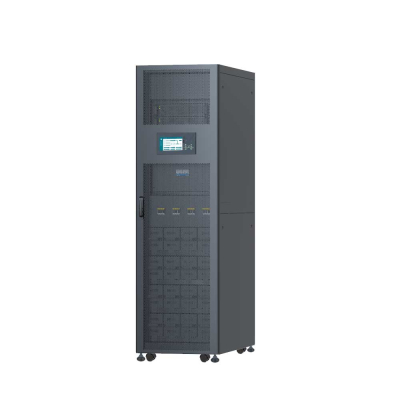
Modular UPS systems are uninterruptible power supply solutions that ensure long-term support for critical environments. They use individual UPS modules that work together to create a scalable solution you can build upon as your needs grow.
So, instead of having to rely on a UPS unit with a fixed capacity, you can save money and enjoy more flexibility. Plus, you won’t need to replace the UPS system when critical load requirements increase, as it’s easy to install extra power modules within your existing infrastructure.
READ MORE...Modular UPS systems are uninterruptible power supply solutions that ensure long-term support for critical environments. They use individual UPS modules that work together to create a scalable solution you can build upon as your needs grow.
So, instead of having to rely on a UPS unit with a fixed capacity, you can save money and enjoy more flexibility. Plus, you won’t need to replace the UPS system when critical load requirements increase, as it’s easy to install extra power modules within your existing infrastructure.
These systems are particularly beneficial in environments planning future expansion and can’t afford any downtime.
Modular UPS systems offer a range of benefits, but deciding whether they’re the right solution for your needs can be challenging. Here’s when they might be a suitable option:
There are many benefits to modular UPS solutions, including scalability, efficiency, and ease of maintenance.
A primary advantage of modular UPS solutions is their ability to scale depending on your needs. For example, you can add power modules as needed.
So, instead of relying on full-system replacements, modular solutions can save money while still enhancing your operations.
Compact operating environments have limited space, making it hard to install large systems. Because modular UPS solutions are compact, they’re ideal when you’re low on space.
Once your needs increase, you can add additional power modules without replacing the entire system.
Most modular UPS setups support N+1 and N+X redundancy configurations, meaning your additional modules will continue to serve as backups when others require servicing or experience faults.
This makes the entire system more reliable and reduces the risk of downtime, ensuring you can continue critical operations.
Engineers can replace or remove modules without shutting down connected loads, thanks to hot-swap power features.
While a conventional UPS system may experience downtime, modular designs ensure you don’t need to shut down vital equipment.
When you use a standard UPS unit, you’ll notice its efficiency suffers at lower capacity. However, opting for a modular UPS system lets you choose which modules are active based on the load you’re running.
Put simply, this ensures efficiency during low-use periods, while also preserving energy and reducing costs.
A standalone UPS unit can struggle to provide reliable support when your power requirements increase. In contrast, modular UPS units can adapt to your environment rather than the other way around. You can add individual modules as needed without replacing the original platform.
Plus, interchangeable modules are much easier to maintain and configure, ensuring reduced disruptions.
One key benefit of modular systems is their versatility in environments where uptime, resilience, and scalability are vital. For this reason, they’re compatible with multiple environments, including:
When choosing a suitable UPS system, it’s important to factor in your electrical power requirements, current environment, and any future expansion needs:
If you’re looking for an affordable modular UPS solution that scales with your needs, our specialists can help. Please get in touch with us today to discuss your needs. We can support you with sizing, site assessments, installation, commissioning, and ongoing maintenance.
Modular UPS systems are uninterruptible power supplies that use interchangeable modules within a shared frame or cabinet. The key advantage of these systems is their ability to expand as your requirements grow, eliminating the need to add a new UPS.
Hot swapping lets you remove and replace power modules without disconnecting the load or shutting down your UPS. It prevents downtime and ensures your operations can continue – even during routine maintenance or when repairs are required.
Yes, and it’s one of the most popular options available. Data centres require constant uptime, and these systems deliver. They also let you scale your systems without having to invest in a new UPS.
We offer a range of services, including modular UPS selection, site surveys, installation, commissioning, and maintenance. Our specialist will also make necessary repairs and replace power modules if required.




Solent Power Ltd (Company Number 12622565) is a company registered in England and Wales. Our registered office is located at Station yard, Bowes Hill, Rowlands Castle PO9 6BP. VAT No. 363504018